
Whistler: A Novel
Ann Patchett’s books affect me the way a few movies have. Her characters emerge from the pages, the scenes take on a “you are there” feel, and the story reaches places in the heart untouched until as a reader you or I identify with the experiences she describes.
[from the dust jacket] Whistler is a story about two adults looking back over the choices they made, and the choices that were made for them. It’s a story about bravery, memory, the often small yet consequential moments that define our lives, and the endless stream of loss that in time comes for us all. Beautiful in its simplicity, it is ultimately about how love endures, and how the feeling of being known by one other person, even for a short period of time, can change everything.
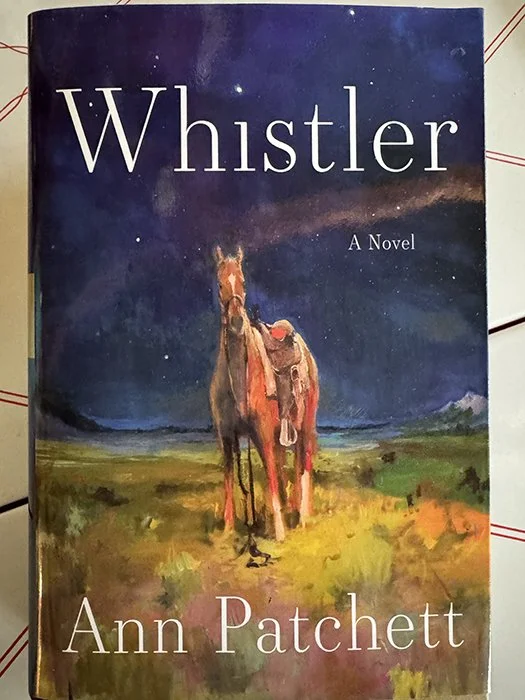
I’ve read so many Ann Patchett books that of course I had to read her latest, published June 2, 2026.
Don’t be fooled by the horse on the book’s cover. The story is not about a horse. But there is a horse story, almost like the center of a Tootsie Roll Pop. The horse story is important to the story about the people.
True? Almost true? Autobiographical?
As soon as I started reading, this book made me think of Ann Patchett’s book of essays, These Precious Days (2021), nonfiction, where among other topics, Ann described her three fathers, marriage to a much older man, lifelong relationship to books (writing, editors, publishers, selling), about parting with deceased parents’ possessions, evaluating our own accumulations as we age, well, enough about her real life to make me wonder how much of Whistler is based on her story? At least, a lot of it is what she knows.
Write What You Know
Advice to writers, “Write what you know.”
I’ve read and heard that statement repeated as if anyone could write a book because everyone has a story to tell. But not everyone can write a book people would want to read.
Ann Patchett writes compelling books. Consistently. She’s won lots of writing awards. This year, Library of Congress Prize for American Fiction (2026): Awarded for her distinguished body of work and mastery of original thought, presented at the National Book Festival.
My eldest daughter’s comment after reading Whistler, “It was just so hopeful and loving and accepting.”
Yesterday, I wrote in my journal six pages to record my own thoughts about Whistler. (Maybe a rough draft for my blog? No, too many spoilers.)
When I finished reading on Sunday, I kept asking myself why the story had affected me.
I didn’t cry at the end. Not a cathartic experience. True to life, death is not side-stepped. Everyone will die, but not every character did.
What made me identify with characters in this book?
Childhood trauma.
The main character, Daphne, is in a car accident at age 9. Her sister Leda is 7, in the hospital following emergency appendectomy. When I was 9 years old, my sister Reneé died in a hospital, age 7, and then my dad died in a car accident three months later.
The circumstances that surround Daphne’s car accident spin her immediate family in different directions, each with their own unhealed wounds. Her step-father Eddie was driving the car.
Actually, the book begins when Daphne is fifty-three, married to a 70-year-old widower. Meeting Eddie again after more than 40 years, a retrospective unwinds, connecting the lives of characters whose stories overlap, however lightly.
Not knowing how other people think and respond to life is a mystery underlying all human relationships. Ann Patchett creates characters who provide honest insight and reasonable explanations for our differences. Somehow, identifying with characters in this fictional story may help readers feel understood and loved.
“The greatest happiness of life is the conviction that we are loved -- loved for ourselves, or rather, loved in spite of ourselves.” ―Victor Hugo
Nobody to Tell
Years ago, in a conversation with my aunt, who I called Auntie, she shared memories of her own childhood trauma. Here she was, nearly 80 years old, recalling the pain, wiping her tears, lamenting, “We didn’t have nobody to tell.” Her words felt so gripping, so precise, because her words described what I felt too, growing up with questions and feelings locked inside and nobody to tell.
So Auntie is telling me. All these years later, opening her emotional heart to surgery.
Take away the hurt that still hurts because no one cared enough when my aunt was a child to ask her if she needed help to process what had happened to her. Children blame themselves.
In Whistler, Daphne’s sister, Leda, is a professional psychologist, with “her therapeutic toolbox.” Daphne’s mother was living in the midst of her own personal cyclone when the car accident occurred, and neither she nor Daphne’s sister knew what happened that night. Daphne’s stepfather Eddie didn’t learn the rest of the story until the reader did.
Where did Daphne’s pain go?
“I packed it away,” I said. “I put the whole thing in a box and shoved it behind the water heater in the basement. Then I forgot about it. Isn’t that what people do? They pack things up and then years later the hire you [Leda, the therapist] to unpack it for them.” (274)
Reading, Writing, and Understanding
Writers, book editors, publishers––people who live inside and outside of books, who make their living with words––know that words can help you and me relate to one another as human beings.
Every writer knows too that each reader will respond differently to the same book. Talk to those in book clubs. Different strokes for different folks. And timing can make a difference too.
Differing points of view extend the opportunity to grow in grace and truth. Our worlds get bigger. Written and read, words in novels tell stories. These situations and stories can contribute to understanding, help make sense of behaviors, identify choices and project outcomes. Connect the dots.
“What lies behind us and what lies ahead of us are tiny matters compared to what lies within us.”
Other people’s stories can ignite our own dormant memories, reveal thoughts and emotions and motivations that lie hidden. Often festering, the healing just beyond reach.
While movies invite viewers into story, it’s much easier to separate self from characters on a screen. Books draw the characters in our own imagination.
Daphne, who I will never meet, reminded me everyone needs somebody to tell.

If you like what you read here, please share https://www.footnotes2stories.com/home
